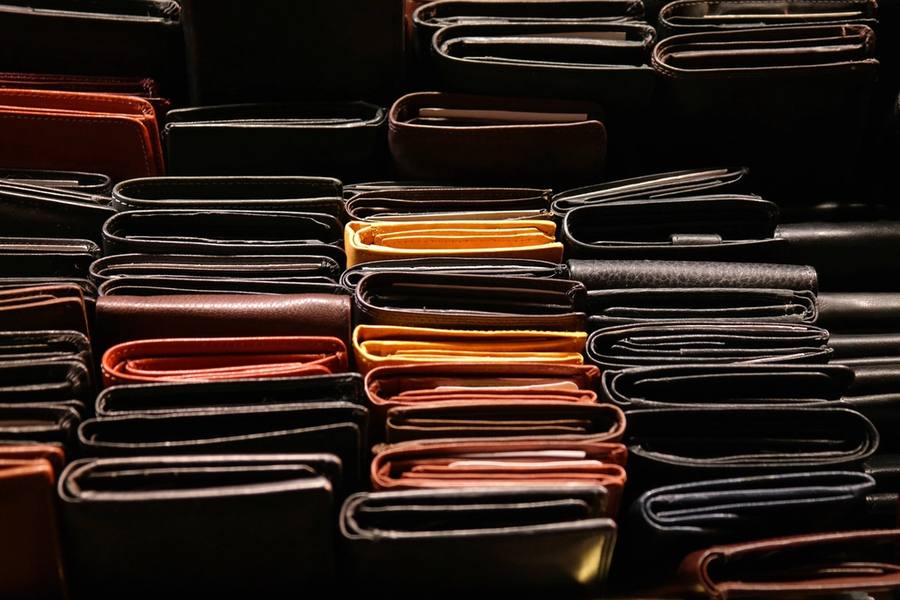
Full Grain Bifold Wallet
Image illustrative (photo de stock) ; ce n'est pas le produit exact.
The Leather Grade Determines Everything
Full grain is the outer hide layer with its surface intact, which is the strongest and most durable part and the one that develops patina.
Genuine leather describes lower split layers after that has been removed, which is weaker and wears through, and the name is misleading.
Bonded leather is ground scraps glued to a backing and it flakes and cracks within a year or two of daily use, which makes it a poor purchase at any price.
Stitching And Construction
Stitching is where wallets fail, and a wallet stitched with strong thread at close spacing lasts far longer than one glued or loosely stitched.
Edges that are sealed and burnished rather than raw resist the fraying that spreads once it starts.
A wallet made from fewer pieces has fewer seams to fail, and heavily panelled designs have more points of failure despite looking more constructed.
Thickness In A Pocket
A bifold in a back pocket is thicker than a card wallet, which tilts the pelvis when seated and wears through pocket linings.
Carrying it in a front or jacket pocket avoids both problems entirely, which is worth considering for anybody who sits for long periods.
Bifolds also encourage accumulating receipts and cards, and the thickness that results is mostly things that did not need carrying.
Breaking In
Full grain leather is stiff when new and softens and conforms over weeks, and a wallet that is supple immediately is usually thin or a lesser grade.
Card slots are tight initially and stretch to fit, and forcing extra cards into a new wallet permanently stretches slots that will then be loose.
Patina develops from handling and light over years, which is the characteristic that makes full grain worth the price to many people.
Repair And Longevity
A stitched wallet can be restitched by a leatherworker where a glued one cannot be repaired at all.
Conditioning occasionally keeps the leather from drying and cracking, particularly if it gets wet.
Note sizes differ between currencies, and a wallet sized for one may leave notes from another protruding above the edge where they crease and wear. Travellers who regularly carry several currencies are better served by a wallet with a generous note section than one cut precisely to a single national standard.
A good bifold lasts a decade or more, which over that period makes it cheaper than repeatedly replacing inexpensive ones.
Card slot count is worth matching to what you actually carry rather than to the maximum available, since a wallet with eight slots invites filling all eight and the resulting thickness is the problem people buy slim wallets to escape. Four to six slots covers what most people genuinely use, and a wallet designed around that number is slimmer by construction rather than by restraint.
The Verdict
A traditional wallet that lasts a decade if it is genuinely full grain and properly stitched, with the terminology actively obscuring which is which.
It is thicker than a card wallet, encourages accumulation, and stiff until broken in.
Avoid bonded leather entirely and treat genuine leather as a warning. Full grain is the only term that indicates the durable part of the hide.
En un coup d'œil
Avantages
- Full grain lasts a decade and develops patina
- Stitched construction can be repaired
- Sealed burnished edges resist fraying
- Softens and conforms with use
Inconvénients
- Thicker than a card wallet in a back pocket
- Encourages accumulating unnecessary contents
- Stiff for the first few weeks
- Misleading terminology across the market
Questions fréquemment posées
What does genuine leather actually mean?
The lower split layers of hide after the strong full grain has been removed, which is weaker and wears through. It sounds like an assurance and is closer to a warning, and bonded leather is worse still.
Why is my new wallet so stiff?
Full grain leather is stiff when new and softens over weeks as it conforms to your pocket. A wallet supple immediately is usually thin or a lesser grade. Do not force extra cards into new slots — they stretch permanently.
Is it worth the price?
A good full grain wallet lasts a decade or more and can be restitched if a seam fails, where a cheap one is replaced every year or two. Over that period the expensive one is usually cheaper.
Spécifications
| Leather | Full grain; outer hide with surface intact |
| Genuine leather | Weaker split layers; misleading name |
| Bonded leather | Glued scraps; fails within years |
| Construction | Close stitching, fewer panels |
| Edges | Sealed and burnished |
| Break-in | Weeks to soften and conform |
| Repair | Stitched wallets can be restitched |
| Carry | Front pocket avoids pelvis tilt |
Résumé
Full grain lasts a decade. Genuine leather is a warning and bonded leather fails within a year or two.
Vérifier le prix sur Amazon